How to Read Vedic Astrology Chart: A Practical Guide

Think of your Vedic birth chart as a cosmic snapshot, a precise map of the heavens at the exact moment you were born. Learning how to read a Vedic astrology chart isn't just about symbols on a page; it's about decoding the unique story of your life path, your personality, and your deepest potential using this ancient interpretation guide.
Your Cosmic Blueprint: How to Read Your Vedic Chart
Welcome to the ancient science of light, Jyotish. Your Vedic chart, often called a Kundali or Lagna Chart, is far more than a collection of planetary placements. It's your personal celestial DNA, offering profound insights into your life's journey, your natural strengths, and the areas ripe for growth. It’s a roadmap that can bring clarity to your past, make sense of your present, and guide you toward a more conscious future.
This guide will demystify this powerful tool, starting with the foundational pillars that make up every single chart. Getting a handle on these core components is the first and most crucial step in turning what might look like a complex diamond shape diagram into a clear narrative all about you.
Getting to Know the Key Players
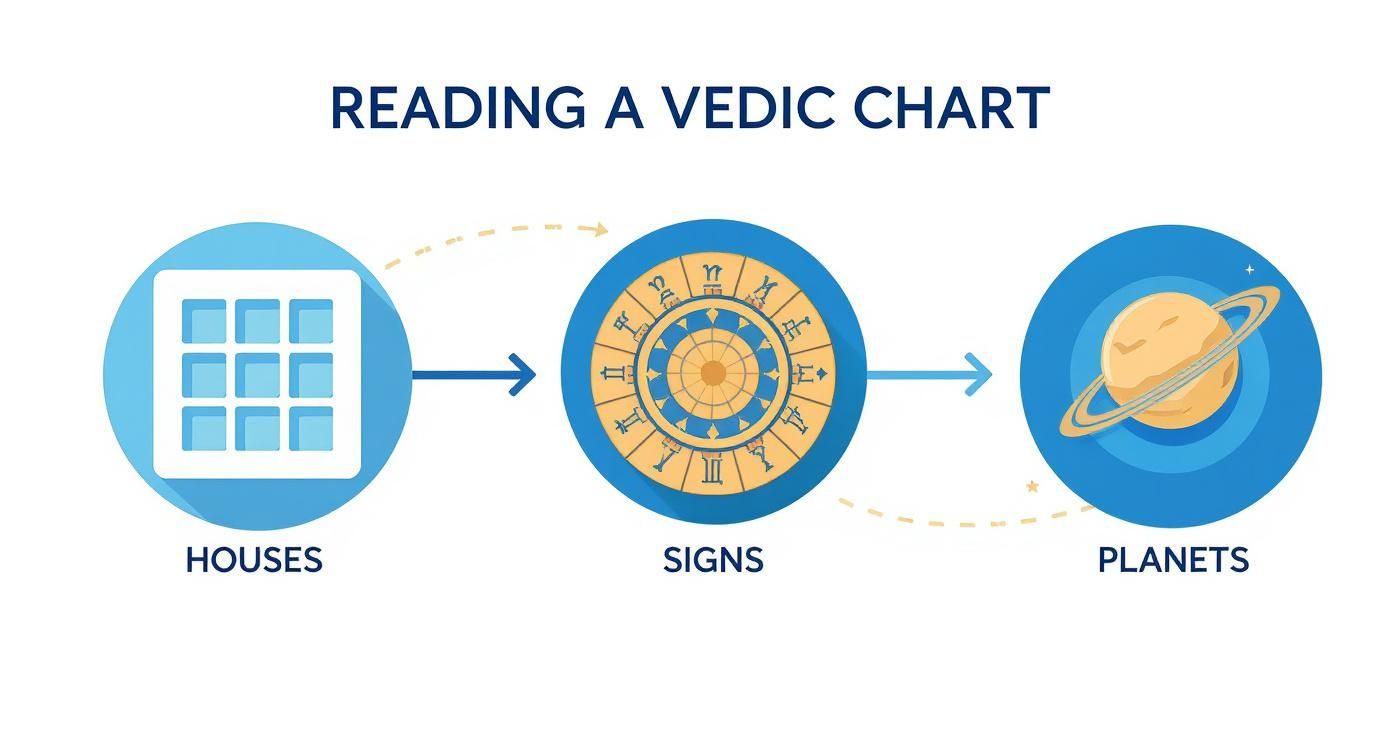
Before we can interpret the story, we need to meet the main characters. Every Jyotish chart is built from three primary elements, and learning to spot them is where your journey begins.
The 12 Houses (Bhavas): Think of these as the different stages or settings in your life story. Each house governs a specific area, like your personality, wealth, relationships, or career. They are the "where" in your chart.
The 12 Zodiac Signs (Rashis): These are the familiar signs, from Aries to Pisces. They add their unique flavor and energy to the houses they occupy, describing "how" the energy in that area of your life will manifest.
The 9 Planets (Navagrahas): These are the dynamic actors in your chart. The planets move through the signs and houses, bringing their distinct energies to activate events and shape your experiences. They are the "what" and the "who."
At the heart of it all is the Ascendant, or Lagna. This is the zodiac sign that was rising on the eastern horizon at your birth, and it locks in the entire layout of your chart. It establishes the first house and sets the sequence for all the others, making it the single most important starting point for any Vedic astrology chart interpretation.
Let's quickly summarize these foundational pieces. Getting these down is your first big step.
Key Components of Your Vedic Chart at a Glance
This table provides a quick summary of the foundational elements you'll need to identify in your chart before diving deeper into interpretation.
| Component | What It Represents | Why It's Important |
|---|---|---|
| The 12 Houses (Bhavas) | The various domains and areas of your life (e.g., career, family). | Defines where the karmic events of your life will play out. |
| The 12 Signs (Rashis) | The energetic backdrop or style of a house. | Describes how the themes of a particular house will express themselves. |
| The 9 Planets (Grahas) | The cosmic forces that deliver karmic results. | Act as the agents of action, influencing events and your experiences. |
| The Ascendant (Lagna) | The sign rising on the eastern horizon at birth. | This is the anchor of your entire chart; it determines your first house and your outward personality. |
Once you can comfortably identify these components, you're ready to start connecting the dots and seeing how they weave together to tell your unique story.
Your Vedic chart is a snapshot of your karma—a balance sheet of past actions that have shaped your present reality. By learning to read it, you gain the power to consciously navigate your path forward, turning predestined challenges into opportunities for growth and self-awareness.
Why Precision Is Everything
I can't stress this enough: an accurate insight depends entirely on precise birth details. You absolutely need the exact time and location of your birth.
Even a few minutes' difference in your birth time can shift the Ascendant (Lagna) and the placement of planets in houses, which can dramatically alter the entire interpretation. Vedic astrology uses the sidereal zodiac, which is fixed to the stars and accounts for the Earth's precession, making it an incredibly precise astronomical system. Modern chart calculators, like the one used by Horazy that rely on Swiss Ephemeris data, can achieve accuracy levels over 99.9%—but only if you feed them the correct birth data.
The North Indian Diamond Chart: Identifying the Ascendant and Houses
Imagine your Vedic chart is a cosmic stage, set for the drama of your life. In North Indian style Vedic astrology, the chart uses a distinct diamond shape. The single most important element is your Ascendant, or Lagna, which always occupies the top-center diamond.
Think of it as the spotlight that illuminates the opening scene. Everything else in the chart flows from this single, critical point. Once you know your Ascendant, you’ve found your first house—the house of self, personality, and your physical body. It's your personal "North Star," guiding the interpretation of your life's unique story.
Mapping Your Life: The 12 Houses in the Diamond Layout
In this North Indian chart format, the houses are fixed in their positions, while the zodiac signs (represented by numbers 1-12) rotate. With your Ascendant locked in as the first house (top center), the other eleven houses, known as Bhavas, follow in a specific counter-clockwise order.
It can seem a bit daunting at first, but thankfully, tools like the chart generator from Horazy do the heavy lifting. They instantly lay out this diamond chart, giving you a clear, personalized blueprint to start from.
Each house holds the potential for a specific set of life experiences. While the nuances are endless, here are the core themes you’ll need to know to get started.
Key Meanings of the 12 Houses
- 1st House (Tanu Bhava): This is you. Your personality, physical body, vitality, and your fundamental outlook on life. It’s the lens through which you see everything.
- 2nd House (Dhana Bhava): This house covers your money, family lineage, the words you speak, and even the food you eat. It’s all about your tangible assets and core values.
- 3rd House (Sahaja Bhava): Think courage, communication, younger siblings, and short trips. This is the house of your personal drive, skills, and how you assert yourself.
- 4th House (Sukha Bhava): The heart of the chart. It governs your mother, your home, emotional contentment, cars, and property. It’s your inner sanctuary.
- 5th House (Putra Bhava): This is where life’s joy is found. It signifies creativity, children, intelligence, romance, and even speculation like investments. It's what you create.
- 6th House (Ari Bhava): Life isn't always easy, and this house shows it. It deals with debts, disputes, daily work routines, and health issues. It’s the house of service and struggle.
- 7th House (Yuvati Bhava): The house of others. It rules marriage, business partnerships, and all one-on-one relationships. It’s how you connect with the world.
- 8th House (Randhra Bhava): The most mysterious house. It governs deep transformations, longevity, inheritances, secrets, and sudden, unexpected events.
- 9th House (Dharma Bhava): Your higher purpose. This house represents your father, gurus, long-distance travel, higher education, and your spiritual beliefs. It’s the house of fortune.
- 10th House (Karma Bhava): This is your public life. Sitting at the top of the chart, it rules your career, reputation, fame, and your actions out in the world.
- 11th House (Labha Bhava): The house of gains! It governs your income, friendships, social circles, and the fulfillment of your greatest hopes and wishes.
- 12th House (Vyaya Bhava): This house represents endings, expenses, and letting go. It also rules foreign lands, isolation, and the ultimate goal of spiritual liberation.
Vedic Astrology Chart Interpretation: Practical Examples
To truly understand how to read a Vedic birth chart, let’s look at how planets in houses create specific life narratives. Here are two common interpretation examples:
Example 1: Saturn in the 10th House (Karma Bhava)
If you see the symbol for Saturn (Sa) in the 10th house (the diamond at the very top), this suggests a career path defined by responsibility and perseverance. Saturn is the taskmaster; in the house of public life, it often indicates someone who achieves great status later in life through hard work. You might experience early delays, but your professional reputation will be built on an unshakeable foundation of discipline.
Example 2: Jupiter in the 5th House (Putra Bhava)
When the great benefic Jupiter (Ju) resides in the 5th house of creativity and intelligence, it acts like a cosmic blessing. This placement often signals a sharp, philosophical mind and a natural talent for teaching or creative expression. It can also indicate happiness through children and a "lucky" streak when it comes to speculative investments or new ventures.
Meeting the Celestial Players: Planets and Signs
Alright, you've got the map of your life—the 12 houses. Now it's time to meet the actors on this cosmic stage. We're talking about the nine planets, known as the Navagrahas, and the twelve zodiac signs, or Rashis. Getting a feel for how these energies interact is a massive step forward in your birth chart interpretation guide.
Think of it this way: the planets are the dynamic forces delivering your karmic experiences. The signs, on the other hand, describe the style or flavor of how those planets express themselves. A planet's entire personality can shift depending on the sign it's visiting.
For example, take fiery, ambitious Mars. Place it in the disciplined, practical sign of Capricorn, and you have a powerhouse for career success. But put that same Mars in the sensitive, watery sign of Cancer, and it can become emotionally turbulent and easily frustrated. This interplay is where the real art of interpretation truly begins.
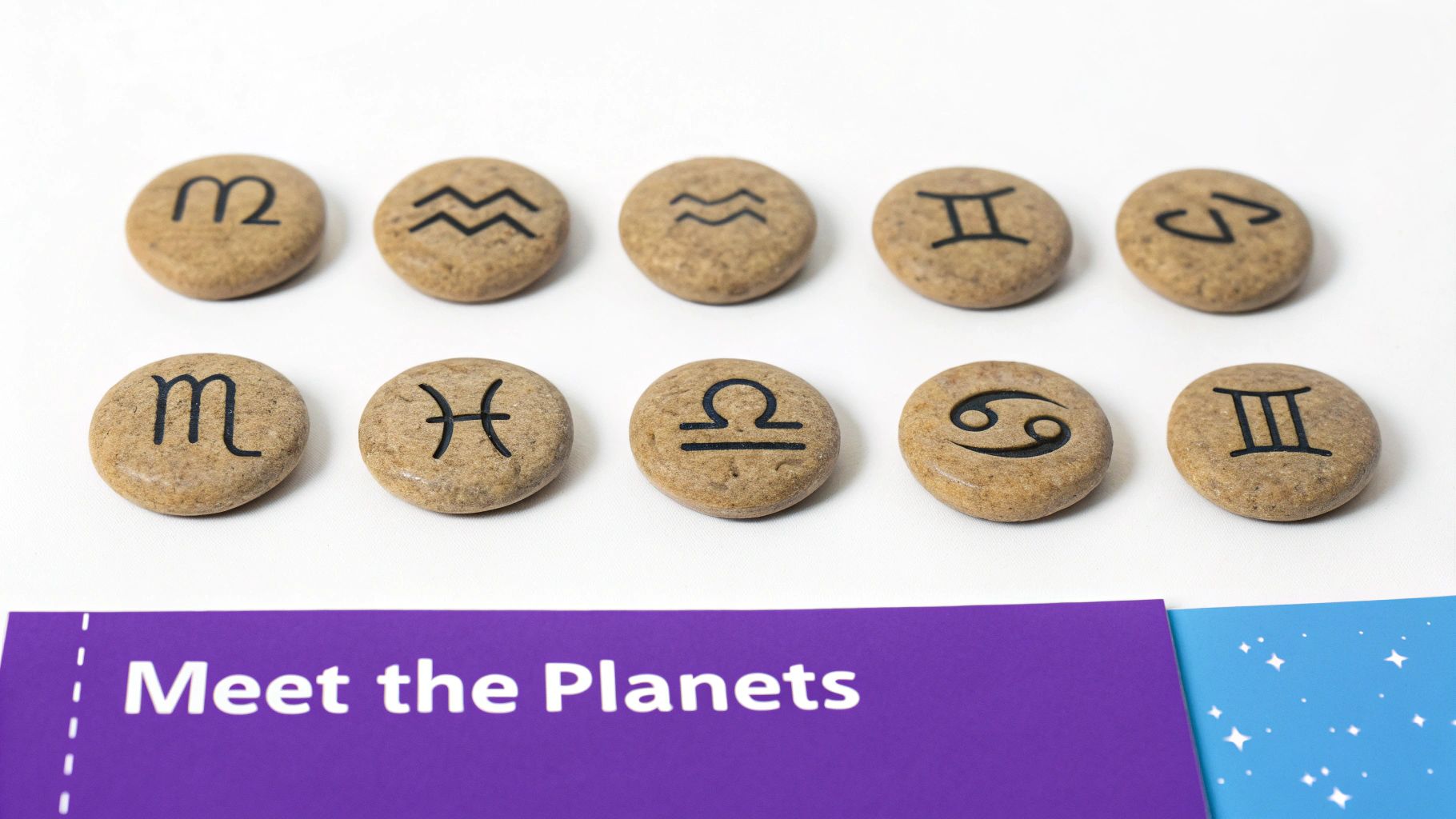
The Nine Planets of Vedic Astrology
In Jyotish, our definition of a "planet" is a bit broader. It includes the Sun, the Moon, and even the two shadowy lunar nodes, Rahu and Ketu, simply because their influence on us is so profound.
They're often grouped into two categories: benefics (gentle) and malefics (harsh). Now, don't get hung up on "good" versus "bad"—malefics are often the ones that push us to grow by delivering tough but necessary life lessons.
- Sun (Surya): The king. This is your soul, your ego, vitality, and sense of authority. It's considered a mild malefic because its intense heat can sometimes burn.
- Moon (Chandra): Your mind and emotions. It reflects your inner world and sense of peace. The Moon is a gentle benefic, especially when it's waxing and bright.
- Mars (Mangala): The cosmic soldier. It's all about action, raw energy, ambition, and conflict. As a strong malefic, its energy can be incredibly constructive or destructive.
- Mercury (Budha): The intellect. This planet governs communication, logic, and learning. Mercury is a chameleon; it's generally a benefic but takes on the nature of the planets it hangs out with.
- Jupiter (Brihaspati): The great teacher or guru. It signifies wisdom, expansion, luck, and spirituality. Jupiter is the most powerful benefic in the Vedic system.
- Venus (Shukra): The artist and diplomat. It rules over love, beauty, pleasure, and relationships. Venus is another top-tier benefic, bringing harmony and enjoyment.
- Saturn (Shani): The great taskmaster. Saturn is about discipline, responsibility, and perseverance. A strong malefic, its lessons are taught through hard work and delays.
- Rahu (North Node): Not a physical planet, but a point of karmic destiny. It represents worldly desires, ambition, and obsession with the unconventional.
- Ketu (South Node): The other lunar node. Ketu is about spirituality, detachment, intuition, and letting go of the past.
The Nine Planets (Navagrahas) and Their Core Meanings
| Planet | Represents | Nature (Benefic/Malefic) |
|---|---|---|
| Sun (Surya) | Soul, Ego, Father, Authority, Vitality | Mild Malefic |
| Moon (Chandra) | Mind, Emotions, Mother, Inner Peace | Benefic (when bright) |
| Mars (Mangala) | Action, Courage, Conflict, Energy | Strong Malefic |
| Mercury (Budha) | Intelligence, Communication, Logic | Neutral/Benefic |
| Jupiter (Guru) | Wisdom, Expansion, Luck, Spirituality | Strong Benefic |
| Venus (Shukra) | Love, Beauty, Pleasure, Relationships | Strong Benefic |
| Saturn (Shani) | Discipline, Responsibility, Delays | Strong Malefic |
| Rahu (North Node) | Worldly Desires, Ambition, Obsession | Malefic |
| Ketu (South Node) | Spirituality, Detachment, Intuition | Malefic |
Assessing Planetary Strength and Dignity
A planet’s ability to deliver on its promises—good or bad—depends heavily on its "dignity," which is just another way of saying its strength based on the sign it's in. A strong planet can lift you up, while a weak one will struggle to express its best qualities.
A huge part of learning how to read a Vedic astrology chart is figuring this out. You have to look at a planet’s sign, its house, and where it sits in relation to everything else. Planets in auspicious houses like the 1st, 5th, and 9th (the trines) tend to shine, while those in tougher spots like the 6th, 8th, or 12th can bring challenges.
Here's a key takeaway from Vedic astrology: a planet's strength isn't just about its natural tendencies, but its current real estate. An "exalted" planet is like a guest of honor at a party—it’s comfortable and able to give its absolute best. A "debilitated" planet is like being at a party where you don't know anyone; it's awkward and struggles to function.
This is where modern tools can really help. A platform like Horazy can automate this complex analysis for you. Its AI-driven system instantly assesses the dignity of every planet in your chart, pointing out your greatest strengths and the areas that might need a little more conscious effort. This kind of automated insight feature handles the heavy lifting, letting you focus on the story your chart is telling.
Weaving the Web: How Planets Talk to Each Other (Drishti)
Alright, you've identified the planets and checked their strength. Now for the really juicy part: uncovering the secret conversations happening across your chart. Planets don't just sit in their own little boxes; they're constantly looking at, influencing, and talking to each other. This cosmic dialogue is called Drishti, or planetary aspects.
Getting a feel for Drishti is when you truly start to see the chart come alive. It’s what separates a basic reading from a genuinely insightful one.
Forget everything you might know from Western astrology about degrees and angles. Vedic aspects are all about houses. Think of it like this: each planet has a powerful gaze, and it casts its energy onto other houses—and any planets living there. This is how you discover the hidden connections in your life, like how your career planet is secretly shaping your relationships, or why your spiritual path and finances feel so intertwined.
The Face-to-Face Connection
The easiest and most fundamental rule of Drishti is this: every single planet aspects the 7th house directly opposite it. It’s a straight line, a direct, face-to-face conversation. A planet in your 1st house of self will always be looking right at your 7th house of partnerships. Simple as that.
The "Special Agents" and Their Unique Gaze
Now, while every planet gets that 7th house aspect, three heavy-hitters—Mars, Jupiter, and Saturn—get special privileges. These planets have extra aspects, allowing their influence to reach much farther across the chart. Getting these down is absolutely key to a deep reading.
- Mars: The fiery planet of action and drive looks at the 4th, 7th, and 8th houses from where it sits. Its gaze injects energy, courage, and sometimes conflict into those areas of life.
- Jupiter: The great teacher of wisdom and expansion blesses the 5th, 7th, and 9th houses from its position. Its glance brings opportunity, optimism, and growth.
- Saturn: The taskmaster of discipline and karma influences the 3rd, 7th, and 10th houses from its spot. Its gaze demands structure, responsibility, and can sometimes bring delays or hard-earned lessons.
A planetary aspect is more than just a vague influence; it's a direct transfer of that planet's unique energy. A beneficial planet like Jupiter can literally uplift and protect the houses it sees. A malefic like Mars can energize them for better or worse. Tracing these lines of sight is like mapping the electrical wiring of your personality.
Unlocking Your Life's Timeline with Dasha Systems
If there’s one thing that truly sets Vedic astrology apart, it’s its uncanny ability to map out the timing of your life. We do this through a predictive system called Dasha, or planetary periods. Think of it as a cosmic timeline that shows you which planet's energy is currently steering your life, bringing its unique themes and lessons to the forefront.
Your birth chart is the static map of your life’s potential—the promises of wealth, relationships, or challenges. But the Dasha system is what breathes life into that map. It's the key that tells you when the events written in your cosmic blueprint are most likely to happen.

Introducing the Vimshottari Dasha System
The most common and trusted method is the Vimshottari Dasha, a 120-year cycle that kicks off based on the Moon's position at the moment of your birth. This grand cycle is divided into major periods, or Mahadashas, with each one ruled by one of the nine planets.
For instance:
- The Venus Mahadasha runs for a full 20 years and often brings themes of love, luxury, relationships, and creative pursuits to the surface.
- The Saturn Mahadasha, a 19-year period, is all about discipline, responsibility, and the rewards of hard, focused work.
- An 18-year Rahu Mahadasha can feel like a whirlwind, ushering in sudden changes, worldly ambition, and a drive toward unconventional goals.
Thankfully, you don't need to do complex calculations by hand. A modern tool like Horazy can generate an automated report that instantly shows you which planetary periods are running the show.
Bringing It All Together: Your Chart's Unique Story
After you've looked at the houses, planets, aspects, and timing, the real magic happens. This is the art of synthesis—weaving all those threads into a single, cohesive narrative that is uniquely yours. A huge part of this is spotting the Yogas, which are special planetary combinations that signal powerful, specific potential.
Think of Yogas as the cheat codes in your horoscope. They're formed when planets sit in certain houses, join together, or aspect each other in just the right way. Finding them by hand takes a lot of practice, but the insights they offer are absolutely worth it.
Letting Technology Do the Heavy Lifting
Manually combing through a chart for potentially thousands of these combinations is a massive undertaking. This is where modern tools brilliantly connect with ancient wisdom. Platforms like Horazy use powerful algorithms to do this complex synthesis for you, generating a detailed automated insight.
In seconds, these systems can scan your chart for countless yogas, check the strength of each planet, and spot subtle influences you might otherwise miss. It's a fantastic way to access the empowering knowledge of your Vedic chart without needing years of study.
Got Questions About Your Vedic Chart? Let's Unpack Them.
What's the Real Difference Between a Vedic and Western Chart?
The single most important distinction is the zodiac they use. Vedic astrology, or Jyotish, is based on the Sidereal zodiac, which is anchored to the actual positions of the constellations. Western astrology uses the Tropical zodiac, based on the seasons.
Because of this fundamental difference, there's a gap of about 24 degrees between the two systems. Your Sun sign and nearly all your planetary placements will likely shift back one sign in your Vedic chart. So, if you've always known yourself as a fiery Leo, don't be surprised to find you're a nurturing Cancer in your Vedic Lagna Chart.
How Can I Get an Accurate Automated Insight from My Chart?
Accuracy starts with your birth data. I can't stress this enough: you need your exact date, time, and location of birth. Being off by even a few minutes can change your Ascendant, which creates a domino effect across the entire chart and can completely alter the story it tells.
Once you have your details, use a high-quality Vedic astrology platform that runs on precise astronomical calculations (look for ones that use Swiss Ephemeris data). A good tool won’t just spit out a chart; it will interpret the complex dance between planets, houses, aspects, and yogas.
I Found a "Bad" Planet in My Chart. Now What?
First off, take a deep breath. Jyotish reveals energetic patterns and tendencies, not written-in-stone doom. A so-called "bad" or debilitated planet simply points to a part of your life that requires more of your attention and awareness. The Vedic tradition is full of practical solutions called upayas, or remedies, such as mantras, gemstones, or acts of service.
Can I Really Learn to Read My Own Chart?
Absolutely, you can. The trick is to start with the building blocks: your Ascendant, the 12 houses, the 9 planets, and the 12 signs. As you begin to see how these cosmic energies connect to your real-life experiences, it will all start to click. Your chart will shift from being a confusing diagram into a living, breathing map for personal growth.
Ready to see what your own cosmic blueprint has to say? With Horazy, you can generate your complete, accurate Vedic birth chart in just a few seconds. Our AI-powered platform delivers a personalized, automated insight and deep analysis to help you navigate your unique life path.
Other Articles

Understand Birth Chart Houses & Their Meanings
Demystify your destiny! Learn to understand birth chart houses and how they reve...
Published May 19, 2026
Read More
Ask Astrologer AI Free: Instant Answers
Get cosmic advice on demand! Ask astrologer AI free questions about your love li...
Published May 18, 2026
Read More
Astrocartography: Best Locations for You
Find your perfect place! Explore astrocartography best locations to live, work, ...